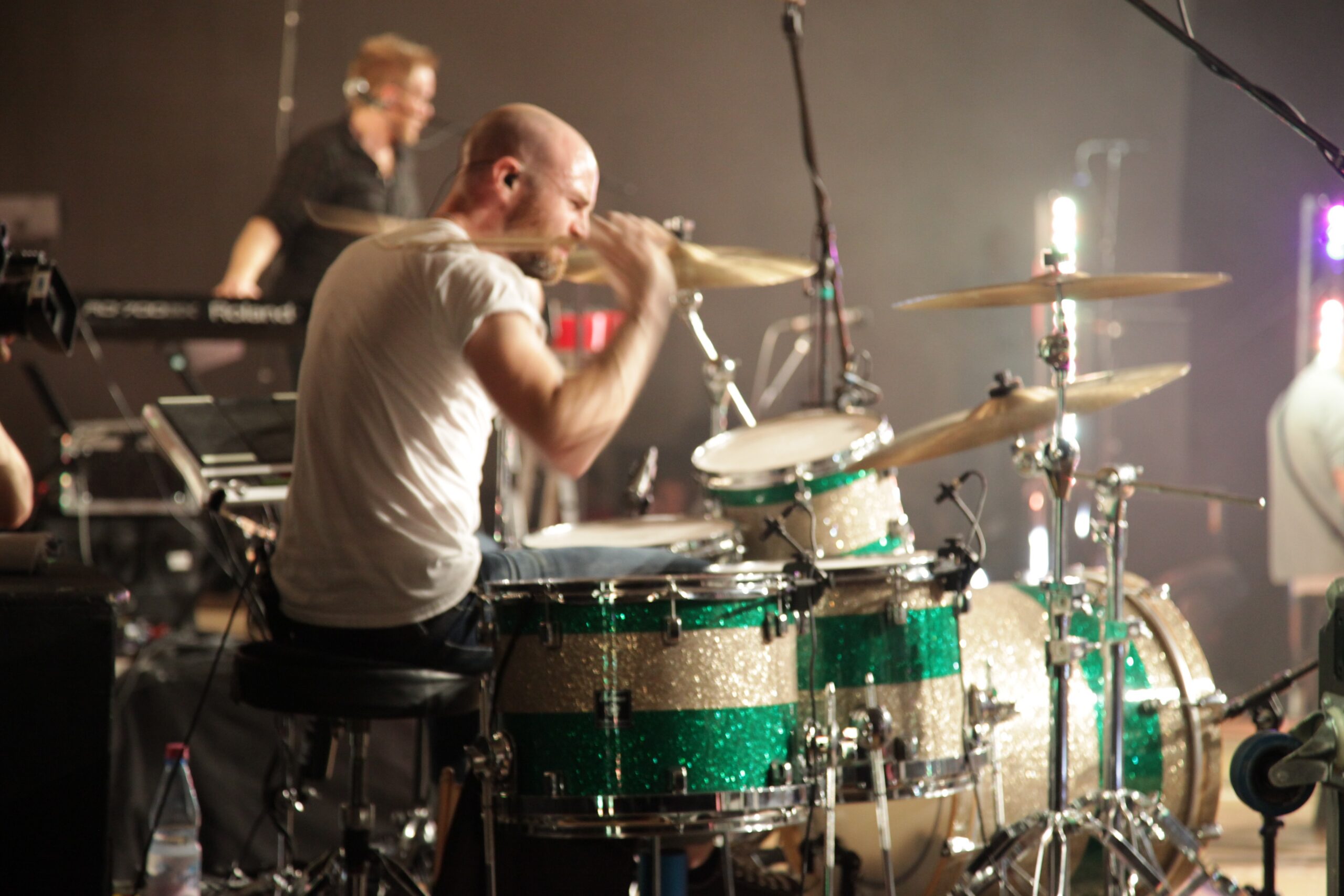
There are two ways you can play drums. One is to play over everybody’s head, to impress them without addressing them personally, playing to an imaginary mass in an imaginary stadium, bashing as hard and loud as humanly possible. And the other one — the way I prefer to play — is to play to the people in front of me, to embrace them, to include them in my journey and make them feel what I am playing on a deeply emotional and spiritual level.
Because I see drums not as a thunder and gunshot imitating tool (and I am well aware that this was intentional by design) but as an instrument to move you with sound, to grab you, to draw you into the music and keep you on your toes with every beat — but even more with every space I leave in the music. I have never understood why we would need to be as loud as possible. My dream situation as a drummer is to be able to play both subtle and loud, and use this range of dynamics to whisper and bring thunder. I love intimate settings, but I need an instrument where I know I can rely on it sounding best, not only when the venue is big enough to afford a sound engineer experienced enough to know how to mix drums.
* * *
This is why I got invested in drum sounds. I learned that modern drums became loud intentionally*, because drum makers were listening to those drummers who play the big crowds, who only hear their drums through microphones. And while that is totally okay, I also realized that these drums simply lack when you play acoustic. Even worse, these drums were not even made to be played in a room.
Where do they think we drummers play? On the moon? How could we develop drums to ignore the places we play them in, and make them dependent on post-production for good sound? Are there any real acoustic drums that deserve the name?
Now here it gets interesting, because drums were not always that way. Drummers were not always that way. There is that drummer who got his hands on a 1950s drum kit, still equipped with original calf heads, and he is not only amazed by the great sound quality, but he also instantly discovers what makes this drum kit so special: it is built to be played acoustic. He did not attempt to mic the drums — he just used a distant room mic to capture the actual sound.
* * *
So what shall we call drums for acoustic settings — drums that sound full, warm, complete, as opposed to „loud, harsh, unbalanced“ until miked and processed and amplified? Because we already have a name for the other, but it got forgotten, because it got the default: Stage Drums. Maybe Vintage, because that is how drums were built by default until the late 50s and early 60s. But the term „vintage“ has today often been used to replicate instruments that were actually built between the late 60s and 80s, which was the time when the modern drum kit was born. Then there were „Studio Drums“, a term that was coined together with „Stage Drums“, but when we look at the categories of drum stores online, we can’t even find „Jazz drums“ (which, as we all probably agree, is a regular drum kit with a smaller kick, usually 18″, as opposed to the 20″ kick for the studio and the 22″ or larger for Stage drums…). Why is it that way?
Compare this with guitars: there are so many different ones, and we do have names for them, so we understand what we talk about when we refer to them. If I said „acoustic guitar,“ you would ask: which one? A classical guitar? A dreadnought? A jumbo? Maybe a resonator guitar? You can not make the instrument an inch larger or smaller without inventing some new instrument, with new properties and sound.
When it comes to drums, we distinguish between „acoustic“ versus electronic. That’s it. It seems like we already consider them as „pads that trigger a percussive sound, which properties will be determined in the mixing process“. All nuance is gone. Each drummer has to find out by themselves what works for them and what does not. You cannot simply walk into a store, explain to the staff that you are playing drums in an acoustic setting and that you need drums for that. They will look at you with blank eyes, and then suggest either a cajon or e-drums.
E-drums, for god’s sake. How am I supposed to get connected with my audience on a spiritual level when I hit pads instead of real drums?
* * *
We seriously need to reclaim the words acoustic drums for what the actual words mean: an instrument built to excel in acoustic situations without the help of amplification. Anybody who plays another acoustic instrument but drums will understand what I am talking about.
Acoustic drums. Can we talk?
*) a drum set build and played in 1950 would have been 12-15dB, or up to 30x less loud than a modern drum set. Just so you know…